We analyze premium changes by considering the 9:15 AM values of both Call (CE) and Put (PE) options. This helps in identifying market trends, sentiment shifts, and potential price movements based on the early trading session's option pricing dynamics.
Premium Change Analysis
Premium Change analysis provides traders with real-time insights into how options premiums evolve throughout the trading day. By tracking premium movements against a 9:15 AM baseline, traders can identify optimal entry and exit points while monitoring the combined effects of time decay, volatility changes, and underlying price movements.
Baseline Reference Point
9:15 AM Baseline: All premium changes are calculated relative to the opening premium at 9:15 AM, providing a consistent reference point for intraday analysis. This baseline helps traders understand how much premium has been gained or lost since market open, accounting for overnight changes and early morning volatility.
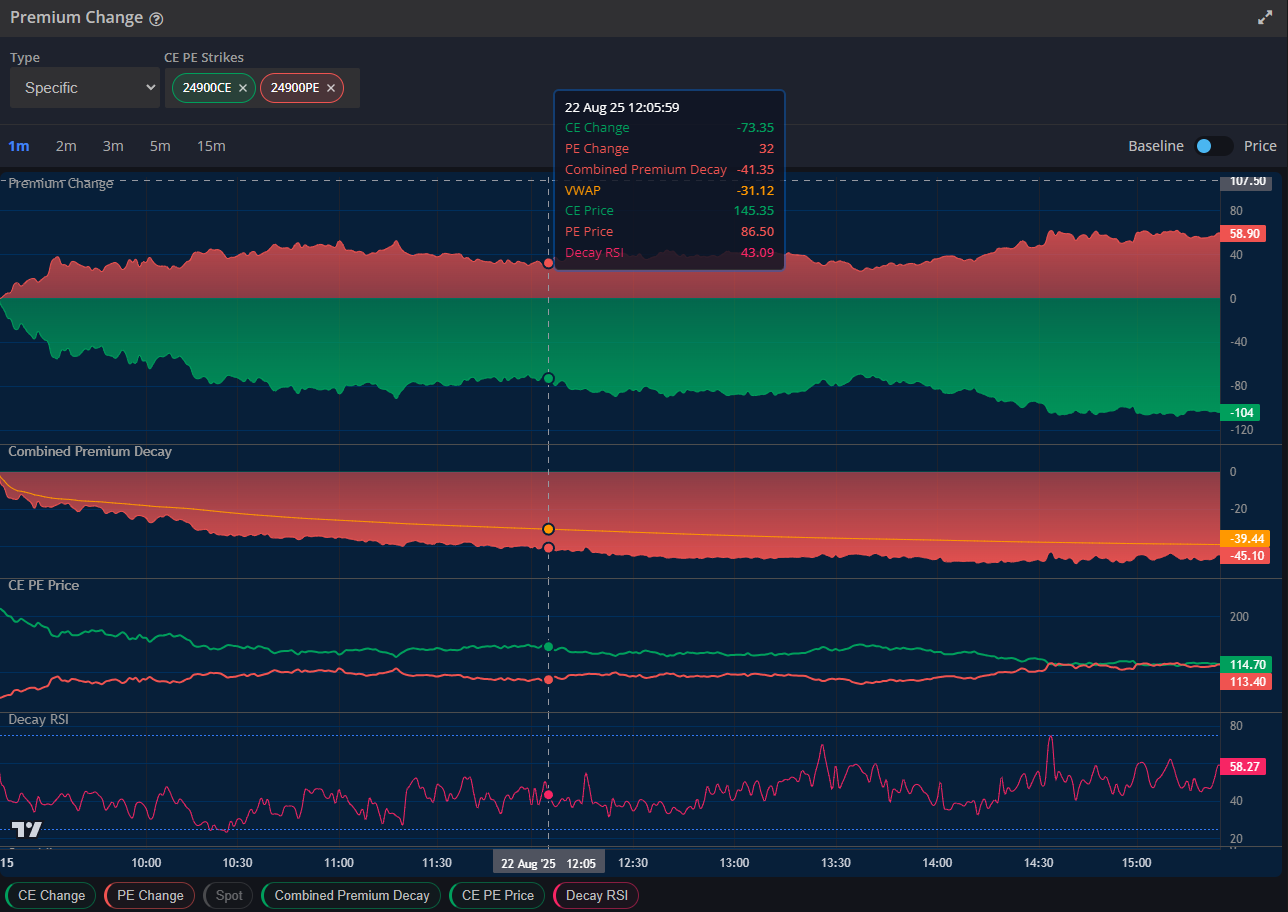
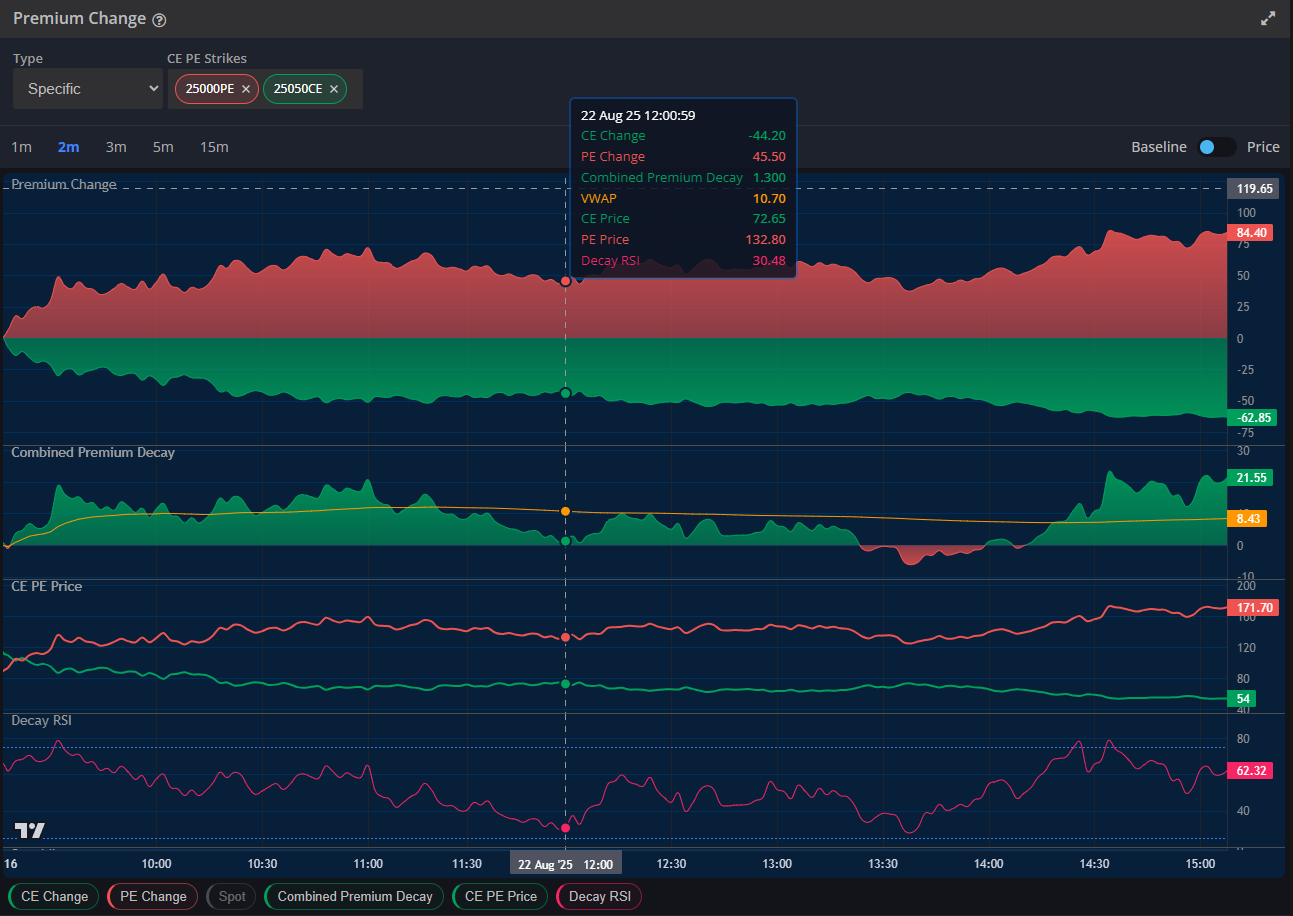
Premium Decay Change: RSI, CE PE Price, Decay linePremium Decay Change: Premium increase and decrease
Understanding Premium Change Components
Premium Change analysis breaks down the complex factors affecting options pricing into measurable components. Each element contributes to the overall premium movement, and understanding their individual impacts helps traders make more informed decisions.
Component
Description
Impact on Premium
Measurement Method
CE Change
Call option premium change from baseline
Positive when calls gain value
Current CE Price - 9:15 AM CE Price
PE Change
Put option premium change from baseline
Positive when puts gain value
Current PE Price - 9:15 AM PE Price
Combined Premium Decay
Time decay effect on both options
Always negative, accelerates near expiry
Theoretical decay from time passage
VWAP Reference
Volume-weighted average price baseline
Shows institutional interest levels
Cumulative volume-weighted pricing
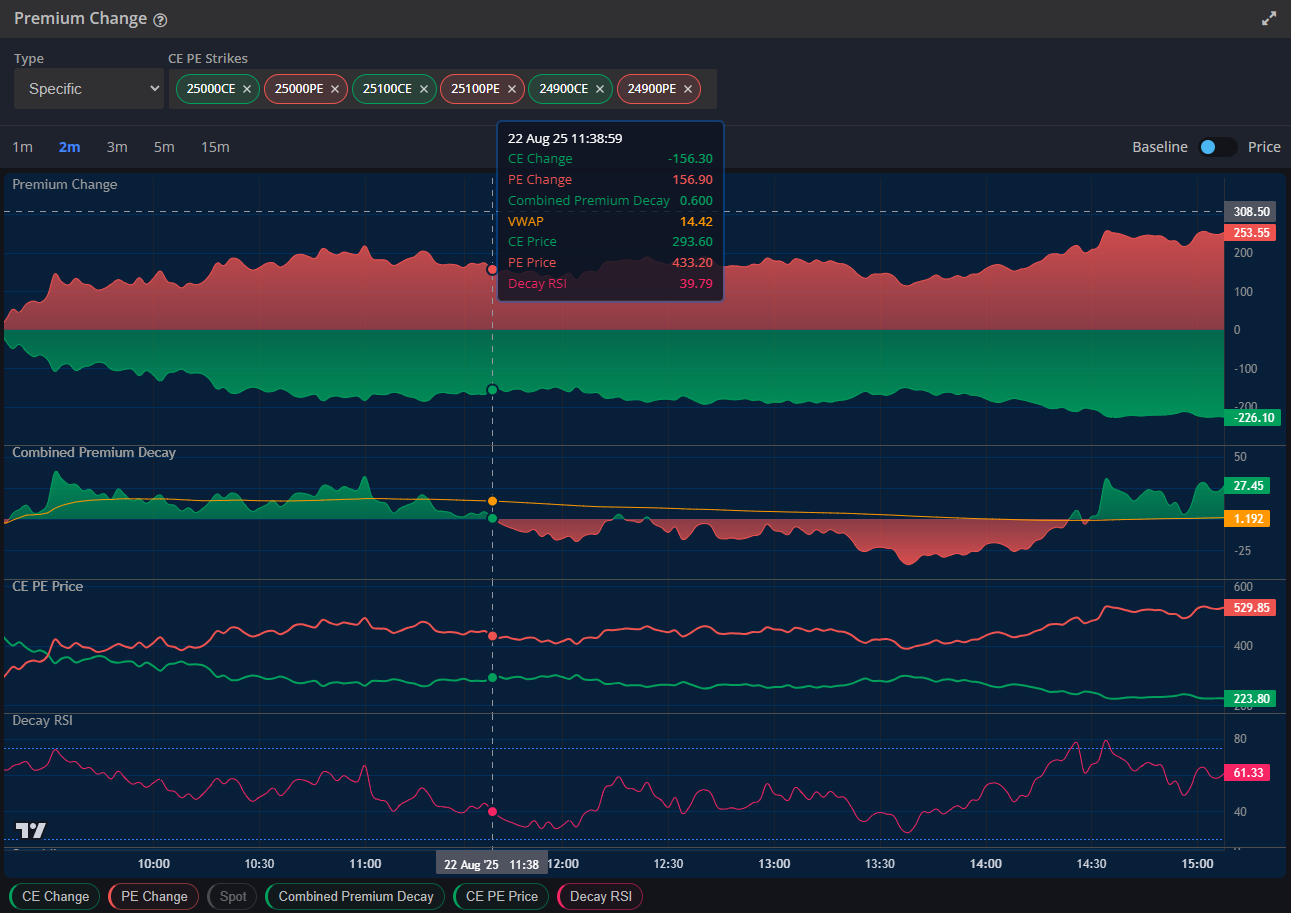
Premium Decay Change: Multi Strikes select
Interpreting Premium Change Patterns
Different premium change patterns reveal important market dynamics. Traders can use these patterns to identify potential trading opportunities and manage existing positions more effectively.
Directional Movement Impact: When the underlying moves significantly, one side of the straddle/strangle gains while the other loses, creating asymmetric premium changes
Time Decay Acceleration: As expiration approaches, time decay becomes more pronounced, especially in the final weeks before expiry
Volatility Expansion/Contraction: Changes in implied volatility affect both call and put premiums simultaneously, often overriding directional effects
Intraday Volatility Patterns: Opening and closing hours typically show higher volatility, while mid-day sessions often experience lower premium fluctuations
Combined Premium Decay Analysis
The Combined Premium Decay metric tracks the theoretical time decay affecting both call and put options simultaneously. This measurement helps traders understand how much premium is lost purely due to the passage of time, independent of price or volatility changes.
Time Decay Insight: Combined Premium Decay accelerates exponentially as expiration approaches. The final week before expiry can see dramatic acceleration in decay rates, especially for at-the-money options.
Decay Rate Factors
Days to Expiration: Options with fewer days to expiry experience faster time decay, following a non-linear acceleration pattern
Moneyness Impact: At-the-money options experience the highest time decay rates, while deep in-the-money or out-of-the-money options decay more slowly
Volatility Environment: High volatility environments can partially offset time decay through increased option values
Interest Rate Effects: Changes in risk-free rates can affect the theoretical decay calculations, though typically minimal for short-term options
Combined Premium Decay RSI
Decay RSI Interpretation: The RSI applied to Combined Premium Decay helps identify when time decay effects are extreme relative to recent patterns. Values above 70 suggest accelerated decay periods, while values below 30 indicate relatively slower decay phases. Current RSI: 68.57
Trading Deacy Applications
Premium Change analysis serves multiple trading purposes, from position entry timing to exit strategy optimization. Understanding these applications helps traders maximize their options trading effectiveness.
Trading Strategy
Premium Change Signal
Action
Risk Consideration
Long Straddle Entry
High decay RSI + low volatility
Wait for volatility expansion
Time decay acceleration risk
Short Straddle Entry
Low decay RSI + high premiums
Sell elevated premiums
Unlimited loss potential
Position Exit Timing
Accelerating decay patterns
Close losing positions early
Opportunity cost of early exit
Adjustment Triggers
Extreme premium imbalances
Roll or hedge positions
Additional transaction costs
Advanced Premium Analysis Strategies
Sophisticated traders can enhance their Premium Change analysis through advanced techniques that provide deeper market insights and more precise timing signals.
Multi-Timeframe Analysis
1 or 2-Minute Precision Tracking: Ultra-short-term premium movements for scalping opportunities and precise entry timing
3 or 5-Minute Trend Identification: Medium-term premium trends that help identify sustainable directional moves
10 or 15-Minute Pattern Recognition: Longer-term premium patterns that reveal institutional activity and major market shifts
Risk Management Through Premium Monitoring
Continuous premium change monitoring provides essential risk management capabilities, allowing traders to respond quickly to adverse market movements and protect their capital.
Risk Alert System: Set up alerts for extreme premium changes (±50 points from baseline) to catch major market movements early and adjust positions before significant losses occur.
Premium-Based Stop Loss Strategies
Absolute Premium Loss Limits: Set maximum acceptable premium loss amounts based on account size and risk tolerance
Percentage-Based Stops: Use percentage-based stop losses relative to initial premium paid for position sizing consistency
Time-Decay Adjusted Stops: Modify stop loss levels based on expected time decay to avoid premature exits
Volatility-Adjusted Risk Management: Adjust risk parameters based on current volatility environment and premium decay patterns
Key Takeaway: Premium Change analysis with 9:15 AM baseline reference provides traders with comprehensive insights into options pricing dynamics. By monitoring real-time premium movements, combined decay patterns, and RSI indicators, traders can make more informed decisions about position entry, management, and exit timing while maintaining effective risk control.
Conclusion: Premium Change Strategies
Premium Change Divergence: CE premium decreased (-57.10) while PE premium increased (+50.10) → indicates bearish bias.
Combined Premium Decay Negative: At -7, meaning overall premium is reducing → suggests time decay effect favoring sellers.


 OptionLab