In a calendar strategy, you sell the near-term option with higher IV and buy the longer-term option with lower IV. This setup benefits from faster time decay in the short leg while the long leg retains more value.
Calendar Comparison Analysis
Calendar Comparison is a sophisticated analytical tool that compares implied volatility (IV) across different expiration dates for the same underlying asset. This powerful technique helps traders identify optimal entry and exit points for calendar spread strategies by analyzing the volatility term structure and time decay patterns.
Understanding Calendar Comparison
Calendar Comparison analysis involves examining the relationship between near-term and far-term implied volatility to identify trading opportunities. By comparing IV across different expiration cycles, traders can spot potential mispricings and structure profitable calendar spread positions.
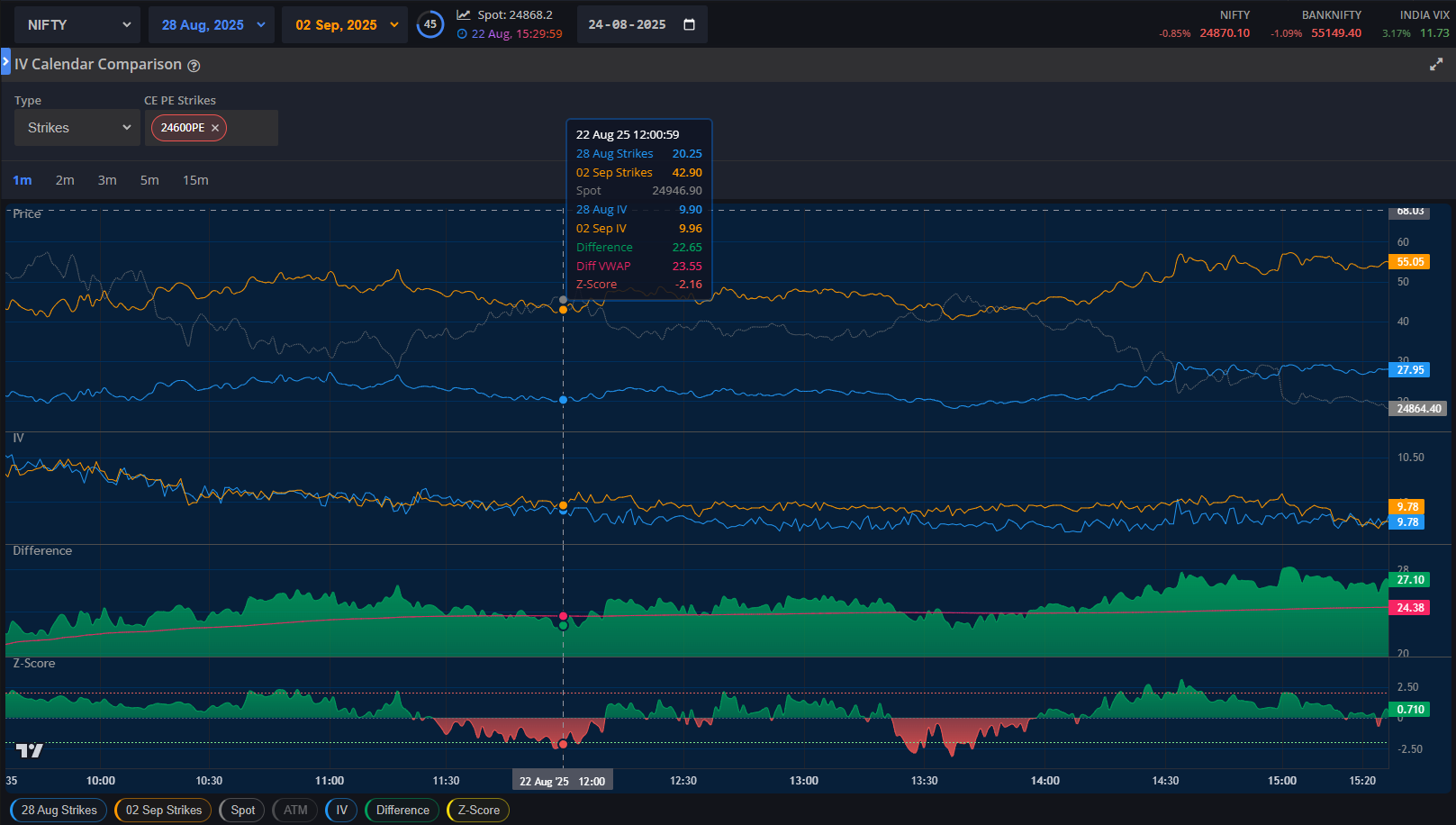
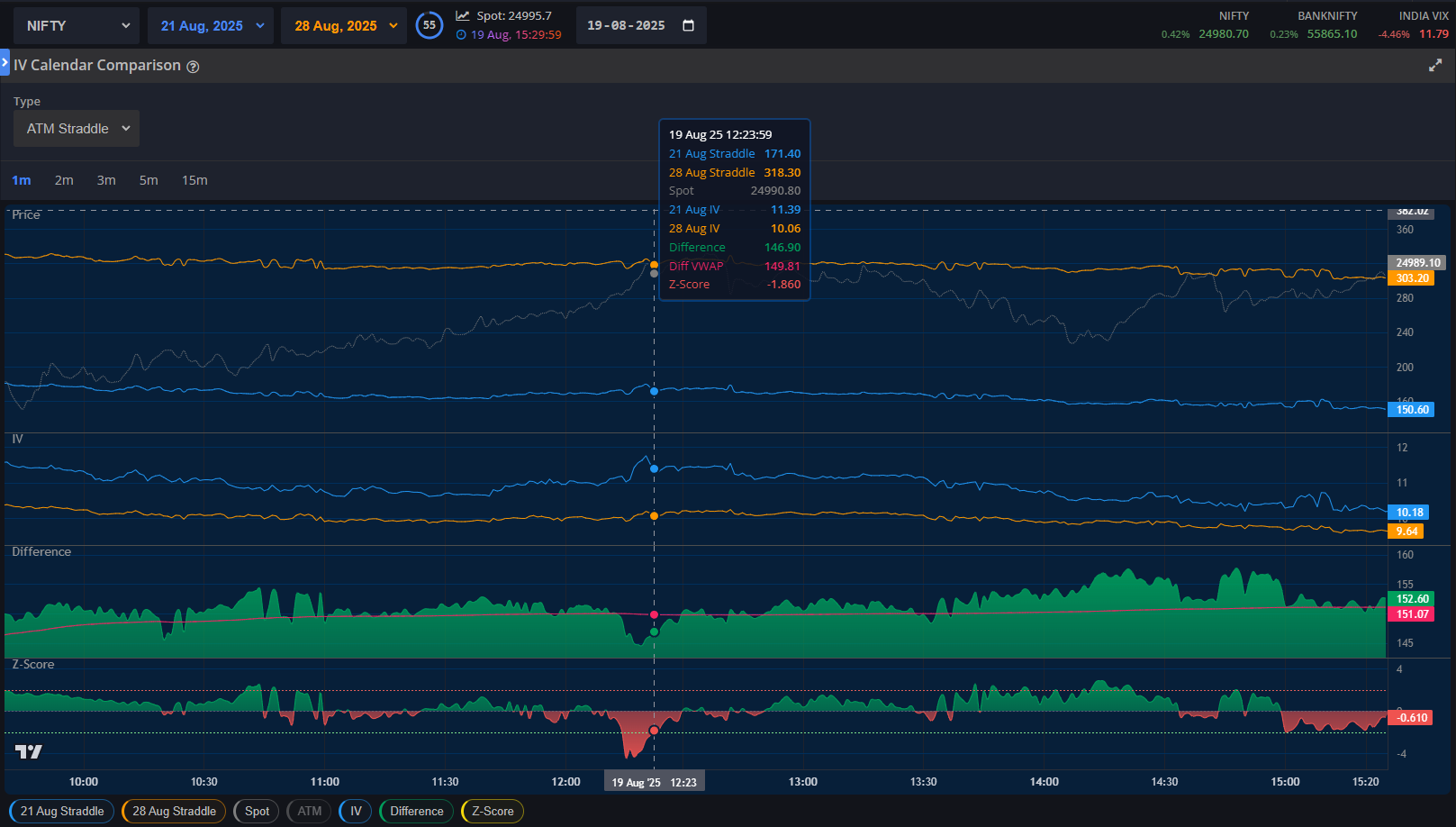
Calendar Comparison: Selected Strikes, IV, calendar difference, Z-score.Calendar Comparison: Rolling ATM call and put, IV, calendar difference, Z-score.
Calendar Spread Analysis
Key Components of Calendar Analysis
Near-Term Expiration IV: The implied volatility of options expiring in the immediate term (typically 1-2 months)
Far-Term Expiration IV: The implied volatility of options expiring in longer periods (typically 3-6 months)
IV Difference: The spread between far-term and near-term implied volatility levels
Z-Score Analysis: Statistical measure showing how far the current IV difference deviates from historical norms
Calendar Spread Mechanics
A calendar spread involves selling a near-term option and buying a far-term option with the same strike price. The strategy profits from time decay acceleration in the near-term option while maintaining exposure to potential volatility expansion in the far-term option.
Strategy Component
Position
Time Decay Impact
Volatility Impact
Near-Term Option
Short (Sell)
Accelerated decay benefits position
IV decrease benefits position
Far-Term Option
Long (Buy)
Slower decay hurts position less
IV increase benefits position
Net Position
Calendar Spread
Benefits from time decay differential
Benefits from volatility term structure normalization
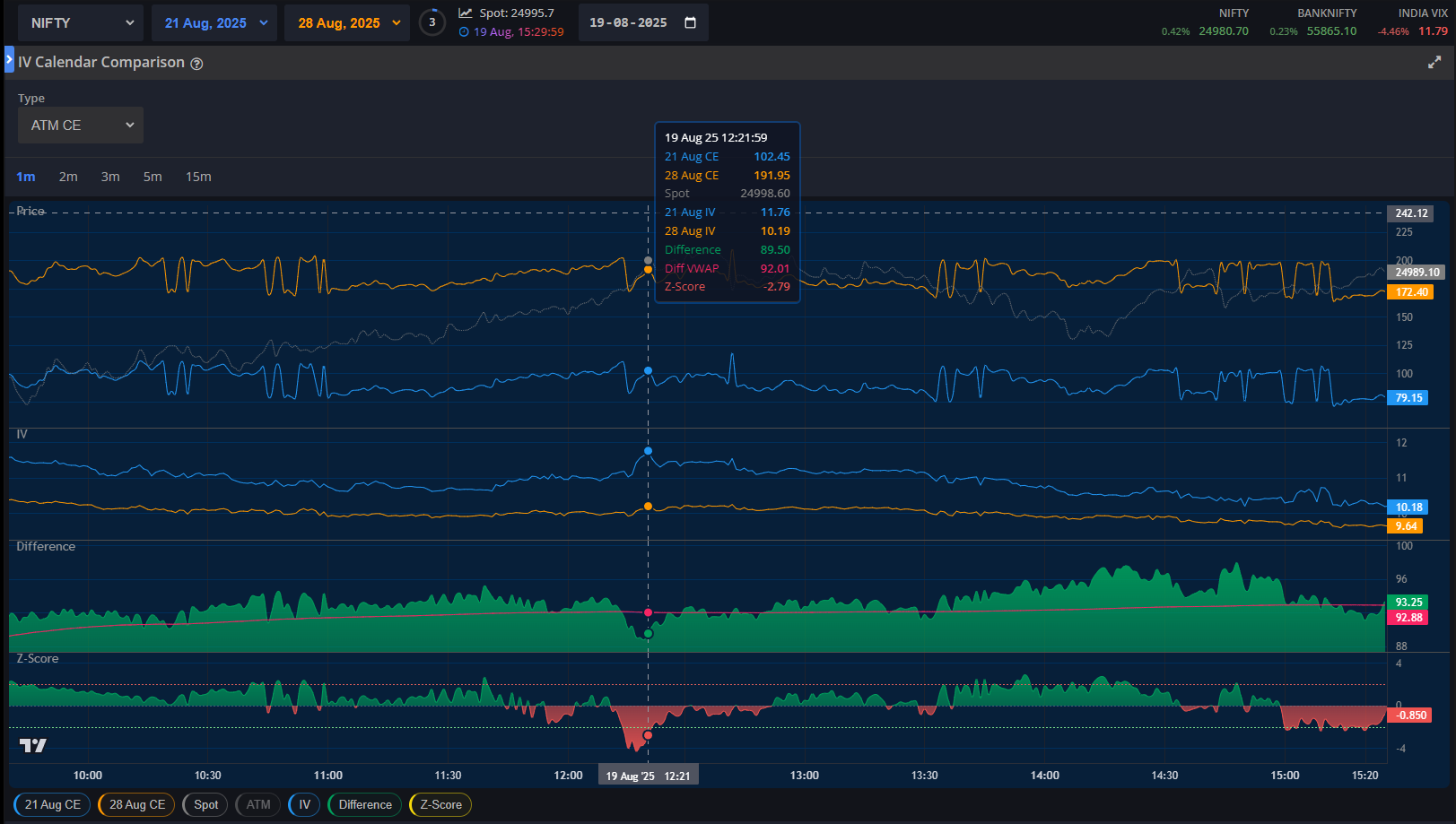
Calendar Comparison: Rolling ATM call, IV, calendar difference, Z-score.
Optimal Entry Conditions
Successful calendar spread trading requires identifying the right market conditions. The Calendar Comparison chart helps traders spot these opportunities through several key indicators.
Entry Signal Analysis
Critical Divergence Patterns:
Z-Score Above +2.0: Indicates the IV difference is significantly above historical norms, suggesting potential mean reversion opportunity
Stable Underlying Price Action: Calendar spreads perform best when the underlying stays near the strike price
Time to Expiration Sweet Spot: Optimal when near-term has 1 week and far-term has 15-30 days remaining
Low Historical Volatility Environment: Reduces risk of significant underlying price movements that could hurt the position
Risk Management Strategies
Calendar spreads require active management due to their sensitivity to both time decay and underlying price movement. Understanding the risk profile helps traders make informed decisions.
Pro Tip: Monitor the position's delta closely. As the underlying moves away from the strike price, the calendar spread can quickly shift from profitable to losing territory.
Key Risk Factors
Risk Factor
Impact on Position
Management Strategy
Large Price Movements
Both options move away from optimal zone
Close position or roll strikes
Volatility Collapse
Far-term option loses value faster
Consider early exit or defensive adjustments
Time Decay Acceleration
Near-term decay overwhelms far-term
Monitor theta decay rates daily
Early Assignment Risk
Short option assigned before expiration
Close or roll positions before ex-dividend dates
Advanced Calendar Strategies
Experienced traders can enhance calendar spread performance through various advanced techniques and modifications.
Double Calendar Spreads: Implementing both call and put calendars at different strikes to create a wider profit zone
Diagonal Spreads: Using different strikes for near-term and far-term options to adjust directional bias
Rolling Strategies: Systematically rolling the near-term option to maintain optimal time decay advantage
Volatility-Based Adjustments: Modifying positions based on implied volatility changes rather than just price movement
Market Conditions and Performance
Calendar spreads perform differently across various market environments. Understanding these patterns helps traders time their entries and exits more effectively.
Optimal Market Conditions: Calendar spreads typically perform best in low-volatility, sideways-trending markets where the underlying asset trades within a narrow range around the chosen strike price.
Performance Across Market Cycles
Low Volatility Periods: Time decay becomes the primary profit driver as volatility remains subdued
Rising Volatility Environments: Far-term options benefit more than near-term, improving spread profitability
Volatile Markets: Increased risk of underlying moving beyond profit zones, requiring active management
Trending Markets: Directional movement can quickly erode calendar spread value, necessitating defensive actions
Key Takeaway: Calendar Comparison analysis provides traders with a systematic approach to identifying and managing calendar spread opportunities. By understanding the relationship between near-term and far-term implied volatility, traders can make more informed decisions about when to enter, adjust, or exit these complex strategies.
Conclusion: Calendar Strategies
Big Price Difference Between Expiries: Calendar Spread Opportunity
IV is Almost Flat: Neutral IV environment, Neutral Calendar, focus on time decay.
Difference Increasing Throughout the Day: Mean Reversion Play, Reverse Calendar Spread if expecting reversion.
Z-Score Swings Around 0 but Turns Negative Midday: Standard Deviation Signal, Buy Calendar Spread when Z-score < -1, exit near 0 or positive.
Spot Stayed in Range: Range-bound market, Double Calendar Spread for balanced theta decay.
Time Decay Advantage: Theta Harvesting, Put Calendar Spread or Diagonal Put Spread if slight bearish bias.
This tool is available as part of the subscription. Please Click here to subscribe.


 OptionLab