The Z-Score is a statistical measure that tells you how far a value is from the mean, in terms of standard deviations. It's used to identify overbought/oversold conditions relative to historical behavior.
What is Z-Score?
Z-Score in options trading measures how far current option prices are from their normal range. It helps traders identify if options are expensive (overpriced) or cheap (underpriced) compared to their usual values.
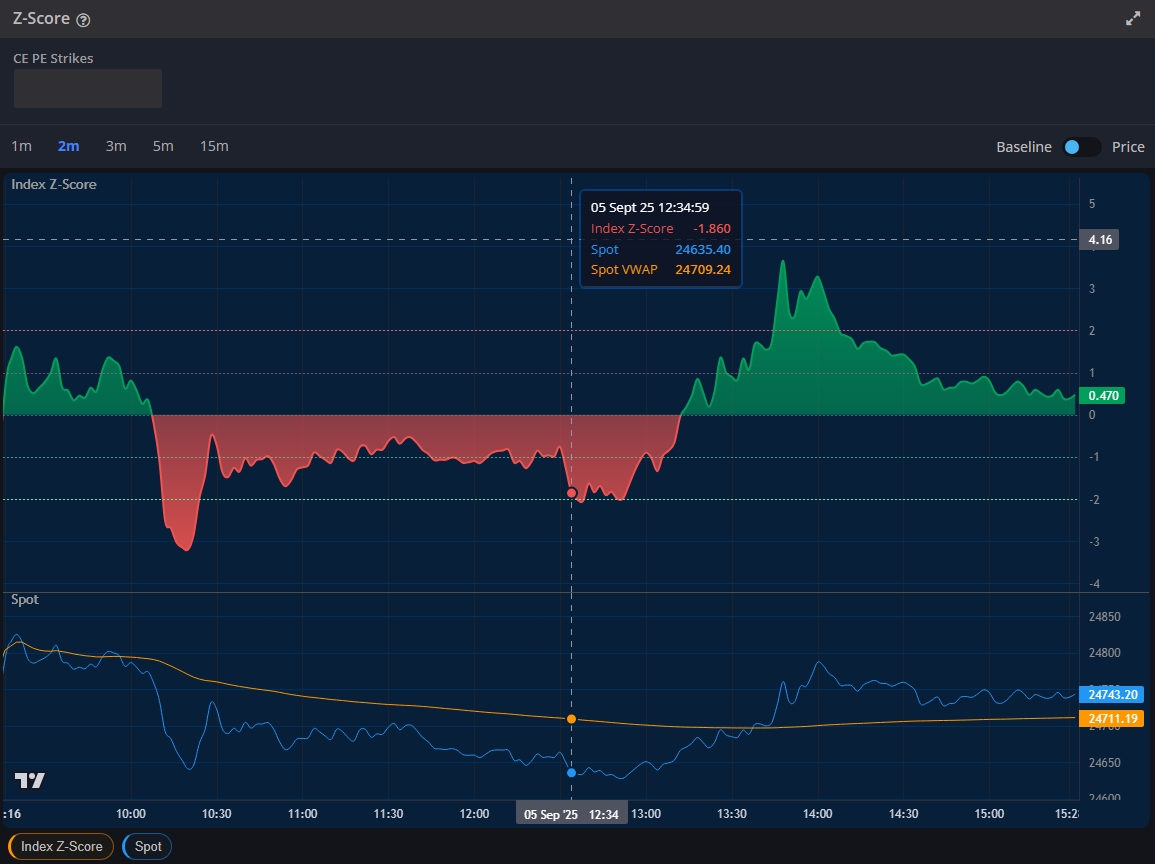
When you see a Z-Score of -1.080 like in your trading screen, it means the current option prices are below their average - potentially a good buying opportunity.
Key Point: Z-Score helps options traders find the best entry and exit points by showing when options are trading at unusual prices.
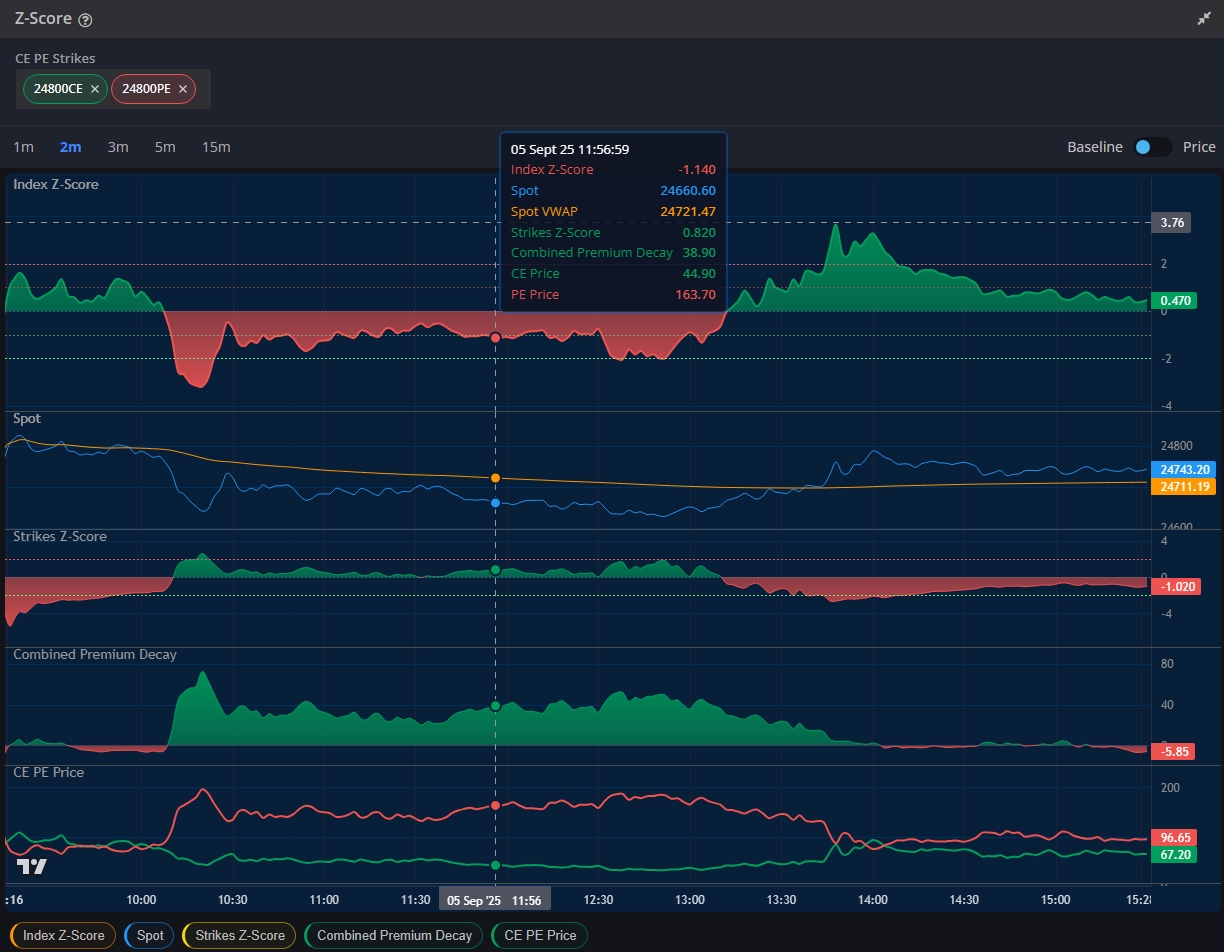
Z-Score with Spot, Spot VWAP.Z-Score with Spot, Spot VWAP and Selected Strikes Z-Score, Call Put Price, Premium Decay.
Z-Score Interpretation for Options Traders
Z-Score Range
Market Condition
Trading Signal
Action
Below -2.0
Very Cheap Options
Strong Buy Signal
Buy straddles/strangles
-2.0 to -1.0
Cheap Options
Buy Signal
Consider buying options
-1.0 to 0
Below Average
Neutral to Buy
Wait for better opportunity
0 to +1.0
Above Average
Neutral to Sell
Consider selling options
+1.0 to +2.0
Expensive Options
Sell Signal
Sell options/collect premium
Above +2.0
Very Expensive
Strong Sell Signal
Heavy premium selling
Options Trading Strategies Using Z-Score
1. Straddle Trading Strategy
When Z-Score is Negative (-1.080 like your screen):
Buy ATM Call (CE) + ATM Put (PE)
Options are cheaper than normal
Good chance for profit when volatility increases
Your example: CE at 46.50 + PE at 156.85 = Total cost 203.35
2. Strangle Trading Strategy
When Z-Score is Positive:
Sell OTM Call + OTM Put
Collect high premium
Profit if market stays in range
Real Trading Example from Your Screen
Parameter
Value
Analysis
Trading Decision
Index Z-Score
-1.080
Options are cheap
Consider buying
Strikes Z-Score
0.650
Strike selection above average
Good strike choice
Spot vs VWAP
24669 vs 24725
Spot below VWAP
Bearish bias
Combined Premium
203.35
Total straddle cost
Monitor for breakout
Premium Decay and Z-Score
Time to Expiry
Z-Score Impact
Strategy
Risk Level
Same Day
High volatility
Quick scalping
Very High
1-3 Days
Medium impact
Short swing trades
High
1 Week
Moderate impact
Standard strategies
Medium
2+ Weeks
Lower impact
Position trading
Low to Medium
Risk Management with Z-Score
Risk Factor
Z-Score Signal
Action Required
Position Size
Low Risk
-2.0 to -1.5
Buy aggressively
Full position
Medium Risk
-1.5 to -0.5
Moderate buying
50-70% position
High Risk
-0.5 to +0.5
Wait and watch
Small position
Very High Risk
Above +1.0
Sell premium
Conservative selling
Advanced Z-Score Trading Tips
1. Combine Multiple Indicators
Use Z-Score with VWAP, volume, and price action for better signals.
2. Monitor Strike Selection
Strikes Z-Score of 0.650 shows good strike choice in your example.
3. Time Management
Best results between 9:30 AM to 3:00 PM on trading days.
4. Volatility Consideration
High VIX with negative Z-Score = excellent buying opportunity.
Quick Trading Checklist
Before Every Trade:
✓ Check Index Z-Score value
✓ Compare spot price with VWAP
✓ Analyze strikes Z-Score
✓ Calculate combined premium
✓ Set stop-loss levels
✓ Plan exit strategy
✓ Check time remaining
Conclusion
Bearish bias from Index Z-Score and PE price strength. Neutral-to-sideways signals from Strikes Z-Score and flat premium decay.
Index Z-Score Negative: Index Z-Score dipped into the negative zone (below baseline). Indicates weakness in spot index compared to its mean → bearish undertone.
Strikes Z-Score Positive: Strikes Z-Score is in positive territory while index is negative. Option strikes (CE+PE) showing relative strength → possible short covering or hedging.
Combined Premium Decay Flat After Spike: Big premium decay spike around 10:00–11:00, then stabilizes. Writers actively booked theta gains early, now market is in premium balance.
CE vs PE Price Divergence: PE price (red) higher than CE price (green) for most of the session. Put side more expensive → traders hedging downside.
Spot vs VWAP: Spot trades above VWAP after mid-session recovery. Buyers stepped in, possible short covering rally from intraday lows.
Z-Score Divergence Across Index vs Strikes: Index Z-Score stayed negative, while Strikes Z-Score stayed positive. Options market not fully confirming index weakness → possible range-bound
Remember: Z-Score is a powerful tool, but always combine it with proper risk management and market analysis. Your screenshot shows a Z-Score of -1.080, which suggests a potential buying opportunity in current market conditions.
This tool is available as part of the subscription. Please Click here to subscribe.


 OptionLab